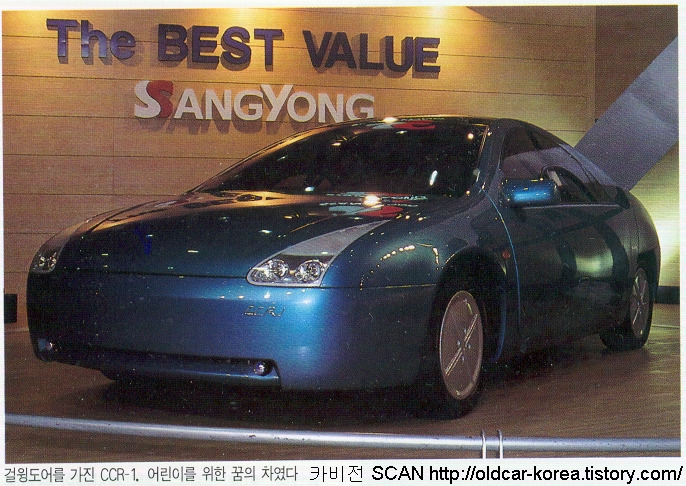
The SsangYong CCR-1: An Early Korean EV Experiment

Edited by Volta Kessrin
Models, Pricing & Buying
Updated September 27, 2026
3 min read
1 linked source
The SsangYong CCR-1, an electric sports car, was unveiled in 1995, marking an early attempt by SsangYong Motor to enter the electric vehicle market in South Korea. This model, known as Clean Car 1, showcased innovative design and technology for its time, but its impact on the current EV landscape remains limited due to its historical context. The CCR-1 is a reminder of the long-standing interest in electric vehicles in South Korea, predating the current EV boom.
Share this story
Why it matters
- ✓Highlights the historical context of electric vehicles in South Korea, showing that interest in EVs is not a recent phenomenon.
- ✓Demonstrates how early innovations can influence modern EV designs and technologies.
- ✓Serves as a case study for buyers and owners interested in the evolution of electric vehicles.
The SsangYong CCR-1: An Early Korean EV Experiment
The SsangYong CCR-1, unveiled in 1995, represents an early foray into electric vehicles by SsangYong Motor, a company that has recently become more involved in the electric vehicle transition. Known as Clean Car 1, the CCR-1 was designed as an electric sports car that showcased advanced technology and a futuristic aesthetic for its time.
What Changed
The introduction of the CCR-1 marked a significant moment in South Korea's automotive history, as it was one of the first electric vehicles produced by a Korean manufacturer. While the CCR-1 did not lead to widespread adoption or commercial success, it laid the groundwork for the current electric vehicle landscape in South Korea, which is now undergoing a significant transformation with a focus on sustainability and innovation.
Why It Matters for Buyers and Owners
- Historical Context: The CCR-1 illustrates that the interest in electric vehicles in South Korea is not a recent development, providing context for current EV initiatives and policies.
- Influence on Modern Designs: Innovations from early models like the CCR-1 can inform the design and technology of contemporary electric vehicles, potentially benefiting current buyers and owners.
- Case Study: For those interested in the evolution of electric vehicles, the CCR-1 serves as a valuable case study, highlighting the challenges and advancements in the industry over the years.
Key Details from Source Material
According to CleanTechnica, the CCR-1 was a forward-thinking vehicle for its time, featuring design elements that seemed to come from a different future. Despite its innovative approach, the CCR-1 did not achieve significant commercial success, which is a common fate for many early electric vehicles. However, it remains a notable part of SsangYong's history and the broader narrative of electric vehicle development in South Korea.
What to Watch Next
As the electric vehicle market continues to evolve, it will be interesting to see how historical models like the CCR-1 influence modern designs and consumer preferences. Additionally, ongoing developments in South Korea's automotive industry, particularly regarding new electric vehicle models and technologies, will be crucial for buyers and owners to monitor. The current shift towards electrification in the automotive sector suggests that lessons learned from early experiments like the CCR-1 may play a role in shaping the future of electric vehicles.
Sources
These are the documents and reports used to build this brief so readers can verify the story directly.
- The SsangYong CCR-1: An Early Korean EV Experiment — CleanTechnicaMEDIA
Reporting notes
EV Signal briefs are written to explain the verified change first, then add the context EV buyers and owners need to understand cost, availability, charging access, eligibility, or ownership impact.
If details are still developing, we try to say what is confirmed, what comes from secondary reporting, and what readers should verify before acting.
Source mix
1 linked source
1 media
Reviewed from: CleanTechnica.
Comments
Log in with
Loading comments…
More in Models & Pricing
Mazda Integrates LiDAR Technology in CX-6e for Enhanced Autonomy in China
Mazda has introduced a new LiDAR suite in its CX-6e electric SUV, enabling advanced Level 2…
2h ago

Ethiopian Runners Excel at 2026 BMW BERLIN-MARATHON; New BMW i3 Debuts
At the 2026 BMW BERLIN-MARATHON, Ethiopian runners Tigst Assefa and Guye Adola achieved remarkable…
2h ago
Volvo's Electric Trucks Named International Truck of the Year 2027
Volvo Trucks has been awarded the International Truck of the Year 2027 for its new generation of…
8h ago
CATL Launches TECTRANS II Battery Platform for Commercial Vehicles
Contemporary Amperex Technology Co. Ltd. (CATL) has introduced the TECTRANS II battery platform at…
8h ago